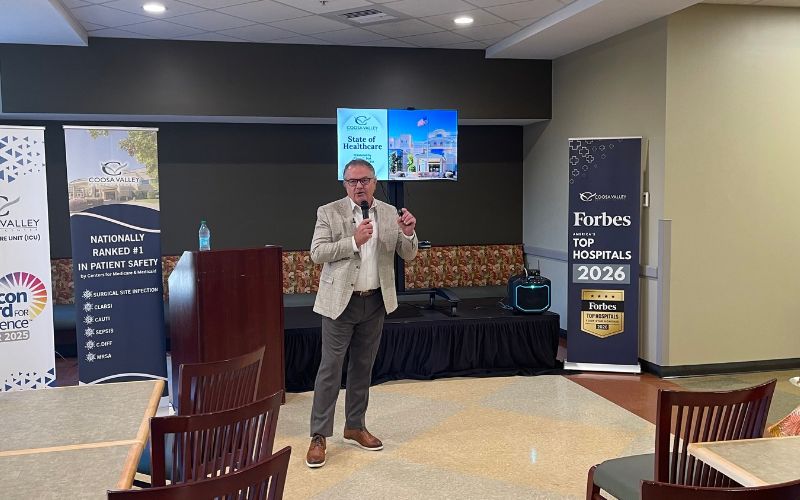
SYLACAUGA, Ala. – The Sylacauga Chamber of Commerce continued its “State of” series on Wednesday, Oct. 21, with a presentation examining the challenges facing healthcare and the impact of Coosa Valley Medical Center on east central Alabama.
The third installment, focused on the State of Healthcare, was held at Coosa Valley Medical Center’s Hickory Street Café. Chamber President and CEO Laura Strickland welcomed attendees before introducing hospital President and CEO Glenn Sisk.
“We’re thrilled to bring the community together to talk about the State of Healthcare,” Sisk said.
His presentation addressed federal health care policies, Alabama’s health care infrastructure, and Coosal Valley Medical Center’s financial challenges, services, and future plans.
Sisk highlighted the financial pressures facing hospitals nationwide, particularly rural providers. According to figures presented, 87 percent of Alabama hospitals operate at a loss.
Coosa Valley Medical Center has averaged $18.28 million in uncompensated care annually over the past five years, dating to fiscal year 2022, and receives no government funding to offset the burden. Sisk also cited a chemotherapy case in which the hospital provided treatment in 2024 involving a drug costing $130,560. The hospital has not been reimbursed for that care.
Federal policy was another major topic. Sisk discussed Medicare reimbursement disparities, noting that a hospital in Anchorage, Alaska, receives $1.93 for every dollar billed under the wage index, compared with 77 cents in Sylacauga.
He also addressed Alabama’s decision not to expand Medicaid under the Affordable Care Act. The presentation noted that 41 states, including Washington, D.C., expanded the program, with the federal government covering 90 percent of expansion costs over time.
Sisk discussed the 2025 federal budget law, known as the One Big Beautiful Bill, which is projected to eliminate $714 billion in health care reimbursements from 2025 through 2034. Estimates cited during the presentation indicated that 190,000 Alabamians could lose insurance coverage.
The law also established the Rural Health Transformation Program, which commits $10 billion over five years to rural health initiatives. Alabama is projected to receive $203.4 million annually during that period.
Coosa Valley Medical Center was awarded approximately $4.72 million in first-year funding for projects including cybersecurity and technology upgrades, mental health services, medical beds, residency training, imaging equipment, and improved access to care.
The hospital’s broader economic role was also outlined. Coosa Valley Medical Center employs 682 people, has an annual payroll of $36.04 million, and generates an estimated $140 million in annual economic impact. It has 124 credentialed physicians and 28 physician extenders.
Looking ahead, planned expansions include increasing the Senior Behavioral Unit to 25 beds, opening a 20-bed adult psychiatry unit, and launching a full-service hospitalist program. A new urology service is expected to open in late 2026. Physician recruitment efforts include four family medicine/obstetrics doctors and additional practitioners.
Sisk urged residents to support local health care and encourage officials to prioritize hospital funding.
“The most important thing we’ll do today as a team is meet people at their point of need,” he said. He added that rural health care infrastructure faces significant economic challenges and needs financial support to survive.