

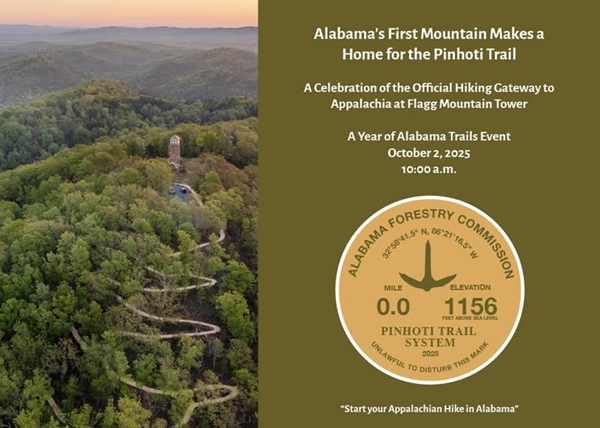
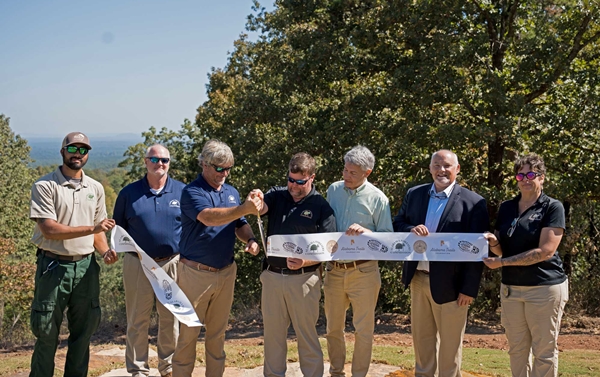
WEOGUFKA, Ala. – As part of “Alabama’s Year of Trails,” the Alabama Trails Foundation and the Alabama Forestry Commission held a special dedication ceremony to recognize Flagg Mountain’s Observation Tower as the southern-most point of the Pinhoti Trail and to celebrate a project that has finally brought reliable water to the mountain from the Stewartville Water Authority.
Flagg Mountain, the southern-most Appalachian peak in Alabama at 1,156-feet, and the tower at 54-feet, the Pinhoti Trail Head was officially moved to the Flagg Mountain Observation Tower in the Weogufka State Forest.
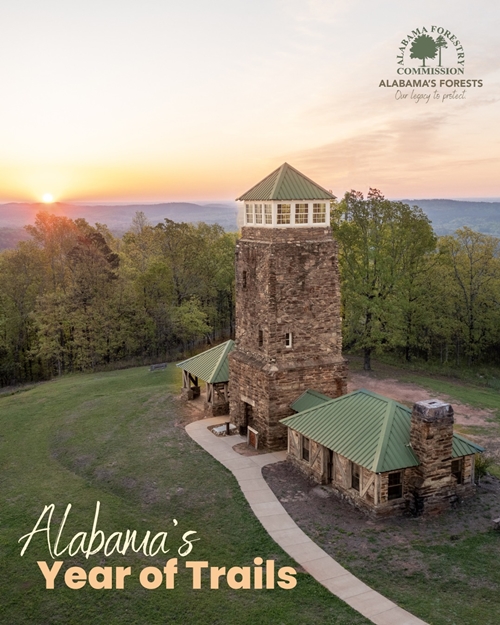
The Civilian Conservation Corps (CCC) built the iconic stone tower in the 1930s, which served as a fire lookout for decades. Its recent restoration returned the tower to its original grandeur, allowing visitors to once again climb to the cab for panoramic views of the surrounding landscape that, on a clear day, allows visitors to see across seven counties.
In keeping with this restoration, the tower will now officially serve as the iconic beginning of Alabama’s longest footpath, the Pinhoti Trail, that connects with the Appalachian Trail in Georgia.
“The restoration and work done on Flagg Mountain is more than just a project; it’s a celebration of Alabama’s natural heritage,” said Paul DeMarco, President of the Alabama Trails Foundation. “By preserving this historic structure and formally linking it to the Pinhoti Trail, we are creating a world-class destination that will attract hikers and nature lovers from across the country while providing a better experience that all Alabamians can enjoy.”
Rick Oates, State Forester of the Alabama Forestry Commission, added, “This partnership demonstrates the great things that can happen when we all work together for a better Alabama. The renovated tower complements the new Pinhoti trailhead. We hope the combination of the two will encourage not only avid hikers, but also outdoor enthusiasts to embark on exciting adventures right here on the peak of beautiful Flagg Mountain. We are proud to help make this historic resource accessible to the public.”


